

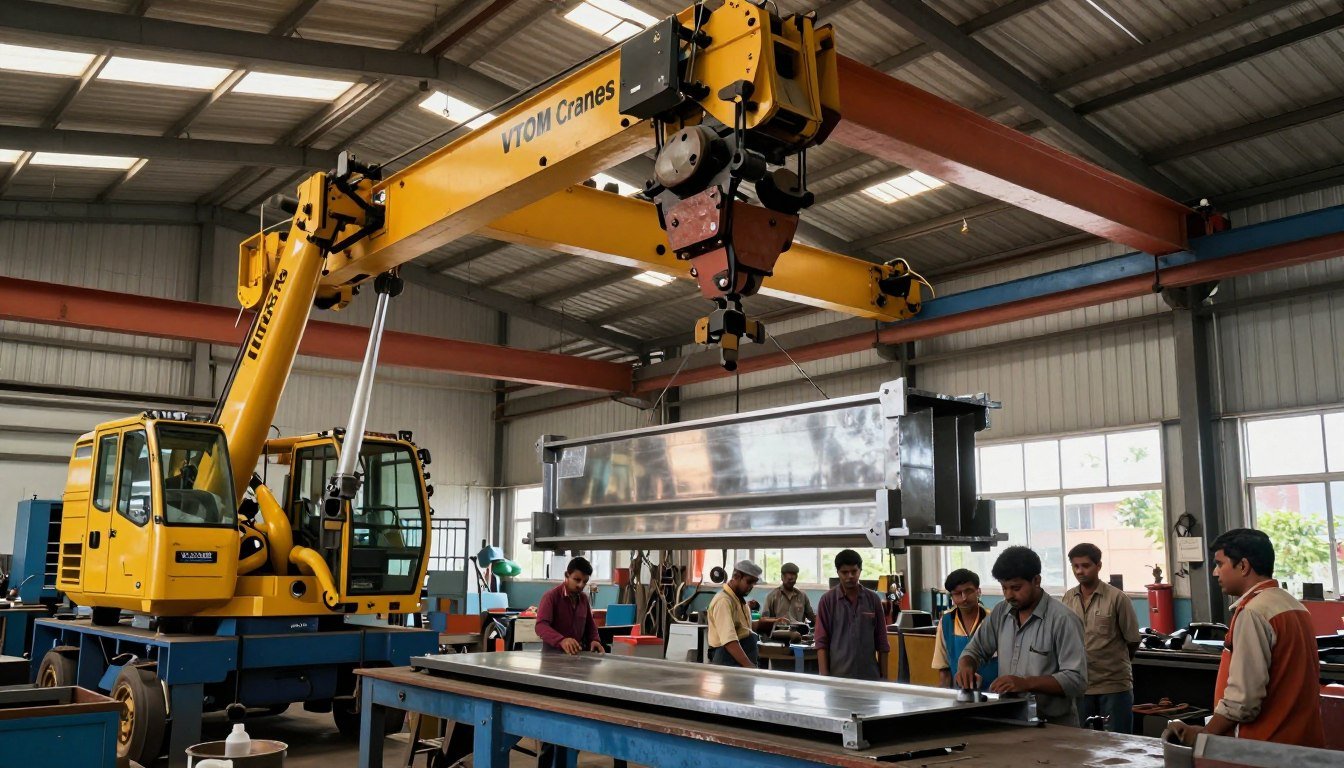
The most important jib-crane safeguards are rated-capacity protection, brakes, emergency stops, travel limits and consistent inspection. These features help control movement and limit common risks, but they cannot remove every hazard. In Indian workshops and manufacturing facilities, a jib crane can support localized lifting and material handling at a work station.
Safe jib crane operation depends on essential safety features, trained workers, clear communication, and a work area suited to the crane. Safety devices alone cannot replace a proper lifting plan or careful operation. Understanding the top safety features in jib crane systems helps industries prevent accidents, protect workers, and maintain smooth material handling operations. This overview explains the main safeguards and practical safety checks required to keep every lift within a verified working area.
Key Takeaways
- Match the crane’s rated capacity and reach to the task.
- Use brakes, travel limits and emergency stops as intended.
- Keep people outside the path of a suspended load.
- Inspect the crane before use and report safety defects.
- Confirm the installation suits the building and work area.
For Indian workplaces, the goal is controlled movement inside a verified work envelope.
What Parts Make Up a Jib Crane?
A jib crane combines a supporting structure, a horizontal boom, a trolley, a hoist and operator controls. The boom is the horizontal beam or track along which the hoist trolley travels. Each part supports a different step in lifting and moving a load.
The support structure is a mast, wall bracket or other mounting frame. It holds the crane in place and transfers forces into the building or foundation. The boom projects from that support across the work area.
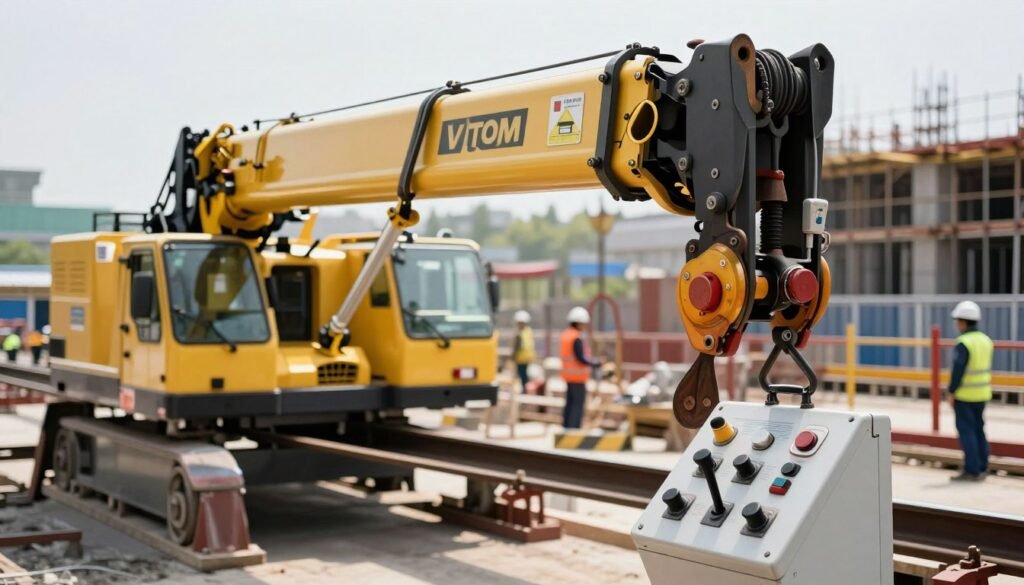
The trolley is the moving unit that carries the hoist along the boom. The hoist raises and lowers the load vertically, using a manual, electric or other drive. Controls let the operator command hoisting and trolley travel.
Some models also let the boom rotate around its support. Other designs move the entire crane on rails or a mobile base. A typical work area forms a fan-shaped radius, often within 10 m.
“Jib” is not an acronym and has no full form. The word names the projecting arm or boom that supports the trolley and hoist. The arrangement lets you lift and move materials around a set work point.
Before planning a lift, confirm that the boom, trolley and hoist configuration matches the task’s required reach. Check the actual layout, not only the crane’s name or general type.
Confirm that the boom, trolley and hoist configuration matches the task’s required reach before planning a lift.
Which Jib Crane Type Fits Your Workspace?
A wall-mounted jib crane often suits a fixed workstation with limited floor space, while a freestanding model suits a dedicated open work area. Choose by support, reach and movement, then confirm that the building can carry the crane’s forces.
Wall-mounted jib designs attach to a wall or column and leave the floor below open. Freestanding cranes use an anchored foundation and need a suitable floor area. Mast-type designs have a floor mount with overhead support.
| Type | Mounting | Rotation | Typical span or capacity |
|---|---|---|---|
| Wall-mounted | Wall or column | 180°-200° | 8-30 ft span; up to 5 tons |
| Freestanding | Anchored foundation | 360° | Up to 50 ft span; up to 15 tons |
| Articulating | Floor, wall, ceiling or rail | Variable pivoting movement | Up to 16 ft span; up to 1 ton |
| Mast-type | Floor-mounted with overhead support | 360° | 10-40 ft span; up to 10 tons |
| Portable | Wheeled or forklift-movable base | Model-dependent | Light-duty capacity up to 0.5 ton |
These are configuration examples, not specifications for every crane. Actual reach and capacity depend on the model and its design. Typical jib-crane spans and capacities show how widely configurations can differ.
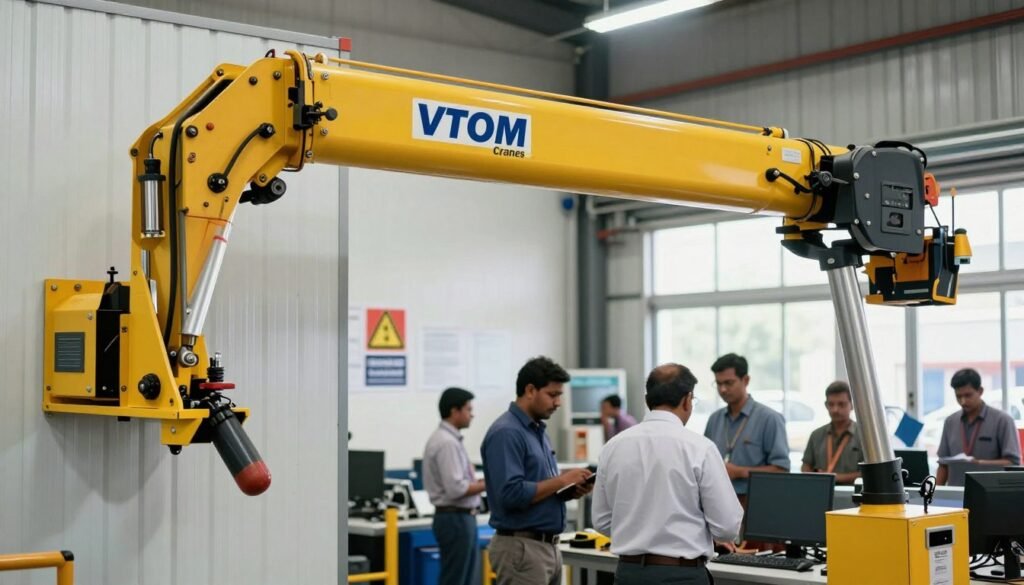
A portable jib crane suits temporary or repositioned light-duty tasks. An articulating arm can pivot around obstacles when a straight reach is not practical. It can serve a machine or work cell with limited access.
A vehicle-mounted jib on a standard vehicle is not the same as a purpose-built truck crane. The first is a jib installed on a road vehicle; the second is a crane designed as a truck-mounted unit.
Compare the required work area with the crane’s reach and range of movement. Check the support structure and actual reach before choosing a mounting type.
What Risks Can Cause a Jib Crane Accident?
A routine lift becomes hazardous when its load, direction of pull or travel path falls outside the crane’s intended use. Four common risk scenarios are overloading, side loading, uncontrolled swing and people entering the suspended-load path.
Each hazard can harm workers or damage equipment. A clear path must include the load’s full swing area, not just the space directly beneath the hook.
- Overloading can stress or destabilize the crane and its support.
- Side loading adds forces the crane is not designed to take.
- A swinging load can strike nearby people, equipment or structures.
- Anyone entering the suspended-load path faces direct injury risk.
Restricted lighting can hide a person or obstacle from the operator. Blocked swing paths and nearby workstations can also cause collisions during rotation. Tight material handling areas need careful planning.
Protective devices can reduce some risks, but they do not replace safe work practices. Workers still need a clear plan and a shared understanding of the movement area.
Keep the full load path clear of people and obstacles before beginning a lift.
Top Safety Features in Jib Crane
A limit switch can stop motion at a defined travel boundary, while an emergency stop gives the operator a way to halt movement in an urgent situation. These safeguards work only when they suit the crane and respond as intended.
Fitted devices and functions vary by crane configuration. A fixed workstation may need different travel limits from a crane that serves several bays. Review the installed features against the work area and crane design.
Overload and Travel Limits
An overload limiter can warn the operator or stop further hoisting when a load exceeds the set limit. An upper-limit stop prevents the hook from rising beyond its permitted travel. Trolley or travel limit switches restrict movement at selected points.
These devices do not make an unsuitable lift safe. Their settings and operation must match the crane’s design. A limit switch also cannot correct a poor load path or a side pull.
Brakes, Emergency Stops, and Hook Latches
Brakes control or hold motion when the operator releases a control. An emergency-stop button halts movement when an urgent danger arises. The operator must know where it is and how to use it.
A hook latch helps keep lifting gear engaged in the hook. It does not make an unsuitable attachment safe, so rigging still needs proper engagement. Fail-safe brakes, slew limits and load limiters are among the features covered by IS 15419 (2004), the jib-crane code.
Rotation Controls, Alarms, and Visibility Aids
Rotation limiters can restrict the boom’s swing to reduce collision risk. Audible movement alarms can alert workers nearby. Anti-collision systems can help when cranes share a work area, where fitted.
A jib crane camera can improve visibility in a blind area. It cannot replace a clear view, a safe load path or an agreed communication method. Cameras can miss hazards outside their field of view.
Pendant and wireless remote controls let an operator command movement from different positions. Variable-speed drives can support more controlled movement. Verify that each control responds correctly before relying on it.
Verify each installed safeguard functions as intended before relying on it during a lift.
How Do Capacity and Design Factors Work?
A crane’s design load has to account for more than the material hanging from its hook. The design must consider rated capacity, hoist-and-trolley weight and forces from impact. These inputs help a qualified designer size the structure for its intended service.
The Indian standard IS 807:2006 covers structural design, manufacture, erection and testing of cranes and hoists. It also classifies cranes from M1 to M8 by operating time and load spectrum.
Build a Realistic Design Load
One jib design method adds a 15% allowance for hoist-and-trolley weight and a 25% impact allowance. These figures belong to that method; they are not universal values for every crane.
Under this method, the capacity-based design factor uses capacity multiplied by 1.4. Its deflection design factor uses capacity multiplied by 1.15. The two factors address different design checks.
Rated capacity is the crane’s maximum rated lifting amount. It does not describe every force used to design the boom. The crane’s working radius, lifting height and duty also shape the design.
Keep Design Factor Separate From Safety Factor
A design factor is a method used in design calculations. A safety factor compares a structure’s strength with the load or stress it must withstand. They are related, but they are not interchangeable terms.
One design reference describes the safety factor as typically 4-8 times greater than the design factor. That comparison depends on the design method and should not be treated as a rule for every crane.
The M1-M8 duty classification reflects operating time and load spectrum, so selection should consider actual use rather than rated load alone. Five useful crane specifications are rated capacity, working radius, lifting height, rotation range and duty classification.
Have a qualified crane designer verify the calculation method and duty classification for the intended service.
How Can Operators Make a Lift Safely?
Before an operator moves a load, the load, attachment and travel path all need to be ready for the lift. Never exceed rated capacity, and lift vertically rather than pulling from the side.
Hoist options include manual, electric chain and pneumatic devices. The right setup depends on the task, but each requires an operator who understands its controls and limits.
Prepare the Load and Work Zone
Confirm the load’s weight and whether the attachment suits its shape and lifting points. Secure it at its center of gravity so it stays balanced. Check that the rigging is engaged before lifting.
Clear the work area and make sure people know the planned movement. Wear suitable personal protective equipment, including safety shoes, gloves, a hard hat and eye protection. Select gear that fits the task and workplace rules.
Control Lifting, Travel, and Set-Down
Raise the load a small amount first and pause to check its balance. If it tilts or shifts, lower it and correct the attachment before continuing. This controlled start can reveal a problem before travel begins.
Hoist steadily and move the trolley with controlled motion. Rotate the boom only within its permitted swing area. Avoid abrupt movement that could make the load swing.
Place the load carefully at its planned location, then release the rigging only when it is stable. Return the hoist and trolley to a safe position after the lift. Keep the load under control through the set-down.
Stop the lift if the load shifts, swings unexpectedly or cannot be placed with controlled movement.
What Should a Pre-Use Inspection Cover?
A pre-use inspection should look for visible damage and abnormal operation across the crane’s structure, lifting system and controls. Stop using the crane and report a safety-critical defect rather than trying an improvised repair.
A visual check is a routine before-use practice. It is not scheduled maintenance or a formal test, which follow their own requirements and procedures.
Use this checklist to cover the main inspection groups:
- Boom, support structure, welds, bolts and connections.
- Hoist function and trolley travel.
- Chain or wire rope, including fastenings.
- Hook, latch and other load-handling attachments.
- Brakes, controls and electrical equipment.
- Guards and safety devices.
IS 14470:1997 includes visual inspection of mechanisms, electrical equipment, safety devices, brakes, controls, crane structures and connections. It also covers guards, hooks, load-handling attachments, ropes and their fastenings.
Look for cracks, deformation, loose parts, fraying, unusual noise or a control that does not work. The IS 14470 visual inspection scope includes the main crane systems and lifting gear. Report defects through the workplace procedure.
A check does not prove that a crane is fit for every task. The operator should record concerns and follow the facility’s reporting process, without adjusting or repairing parts without authorization.
Remove a crane from service when a safety-critical defect needs evaluation or repair.
Which Crane Tests and Indian Standards Apply?
IS 14470:1997 covers crane conformity and lifting-competence tests, including static, dynamic and applicable stability tests. For a non-mobile crane, the static test load is 1.25 P, where P is the manufacturer’s rated capacity.
The test load is raised 100-200 mm above the ground and held for at least 10 minutes. A higher load or longer hold applies when required by national regulations or the purchase contract.
| Test | Purpose | Applicability |
|---|---|---|
| Static | Checks the crane under a specified test load | Non-mobile crane: 1.25 P; hold 10 minutes minimum |
| Dynamic | Checks lifting and crane movement under test conditions | Details follow the applicable procedure |
| Stability | Assesses crane stability | Where applicable |
A successful static test shows no visible crack, permanent deformation, paint flaking or damage that affects function or safety. No connection should be loose or damaged. A failed result needs review before the crane returns to work.
IS 14470:1997 addresses conformity and load-lifting competence tests. IS 807:2006 covers structural design, manufacture, erection and testing. IS 807:2006 crane requirements form part of the design and testing framework.
The standards do not replace applicable regulations, purchase-contract requirements or a qualified assessment. Test details and records should follow the requirements that apply to the crane and site.
Record the test result and resolve any failure before the crane returns to service.
What Should You Check Before Installation?
Before installation, verify that the building structure and work area can support the selected crane and its intended movement. A site assessment must cover the support, clearance and conditions around the crane.
One mast-type example uses 6-inch reinforced concrete support, and mast-type boom-height specifications can reach up to 40 ft. These are configuration examples, not universal requirements or guarantees of fit.
| Site factor | What to verify | Why it matters |
|---|---|---|
| Floor or foundation capacity | Supporting slab and anchorage | Supports crane and lifted load |
| Wall or column strength | Structural capacity and connection design | Limits movement or failure |
| Headroom and boom clearance | Lifting height and full swing path | Helps avoid collisions |
| Environment and work layout | Moisture, corrosion, dust, heat, nearby equipment and floor space | Guides protection and positioning |
Measure the full work area, including the hook’s needed height and the boom’s swing path. Nearby machines, stored materials and walkways affect where the crane can move. These conditions also shape the choice of position and protection.
The reinforced concrete example does not establish that a given slab can carry a crane. A site-specific structural assessment must account for the actual building, crane and load. Engineering review is essential before fixing the support.
At handover, the facility team should receive and confirm:
- Rated-capacity marking on the crane.
- Approved installation drawings.
- Test records and certificates.
- Operating and control instructions.
- Named maintenance responsibilities.
Obtain a site-specific structural assessment before fixing a jib crane to a floor, wall or column.
Conclusion
Safer jib-crane work depends on a suitable installation, functional safeguards and disciplined operation. Match the crane and its safeguards to the task, then use trained operators and a verified installation.
A crane that fits the site still needs an active inspection and a clear work area. Use your facility’s approved procedure to review the site, rated capacity and inspection status before the next lift.
Before the next lift, confirm the crane’s rating, current condition, clear travel path and operator authorization.
About Us – VTOM Cranes
VTOM Cranes is dedicated to providing reliable and efficient industrial crane solutions designed to meet diverse material handling requirements. We focus on delivering crane solutions that support safe lifting, improved productivity, and smooth industrial operations. Our services include crane modernization, breakdown services, crane health assessment, spare parts supply, and crane upgradation. Located in Chikhali, Pune, we serve industries across Pune and Pimpri Chinchwad (PCMC), helping businesses maintain reliable crane operations through professional support and service solutions.
FAQs
Q1. What are the important safety features of a jib crane?
Important jib crane safety features include overload protection, emergency stop buttons, limit switches, safety brakes, hook latches, and rotation limiters. These features help prevent overloading, uncontrolled movement, and workplace accidents.
Q2. How can industries in Pune improve jib crane safety?
Industries in Pune can improve jib crane safety by conducting regular inspections, checking lifting capacity, maintaining brakes and hoists, using trained operators, and ensuring that safety devices function properly. Proper installation and maintenance are also essential.
Q3. Why is regular jib crane maintenance important for factories in Pimpri Chinchwad (PCMC)?
Regular jib crane maintenance helps factories in Pimpri Chinchwad identify equipment defects, reduce unexpected breakdowns, improve lifting safety, and maintain operational efficiency. Inspections should cover the boom, hoist, trolley, hooks, brakes, and electrical controls.
Q4. Which safety checks should manufacturers in Chikhali perform before operating a jib crane?
Manufacturers in Chikhali should check the crane’s rated load capacity, wire rope or chain condition, hook latch, brakes, limit switches, emergency stop, and supporting structure before operation. They should also ensure that the lifting area is clear of people and obstacles.
Q5. Where can industries in Pune, PCMC, and Chikhali get reliable jib crane solutions and maintenance support?
Industries in Pune, Pimpri Chinchwad, and Chikhali can contact VTOM Cranes for industrial crane solutions and support services. VTOM provides crane-related services, including crane modernization, breakdown services, crane health assessment, and spare parts supply.
 Previous Post