

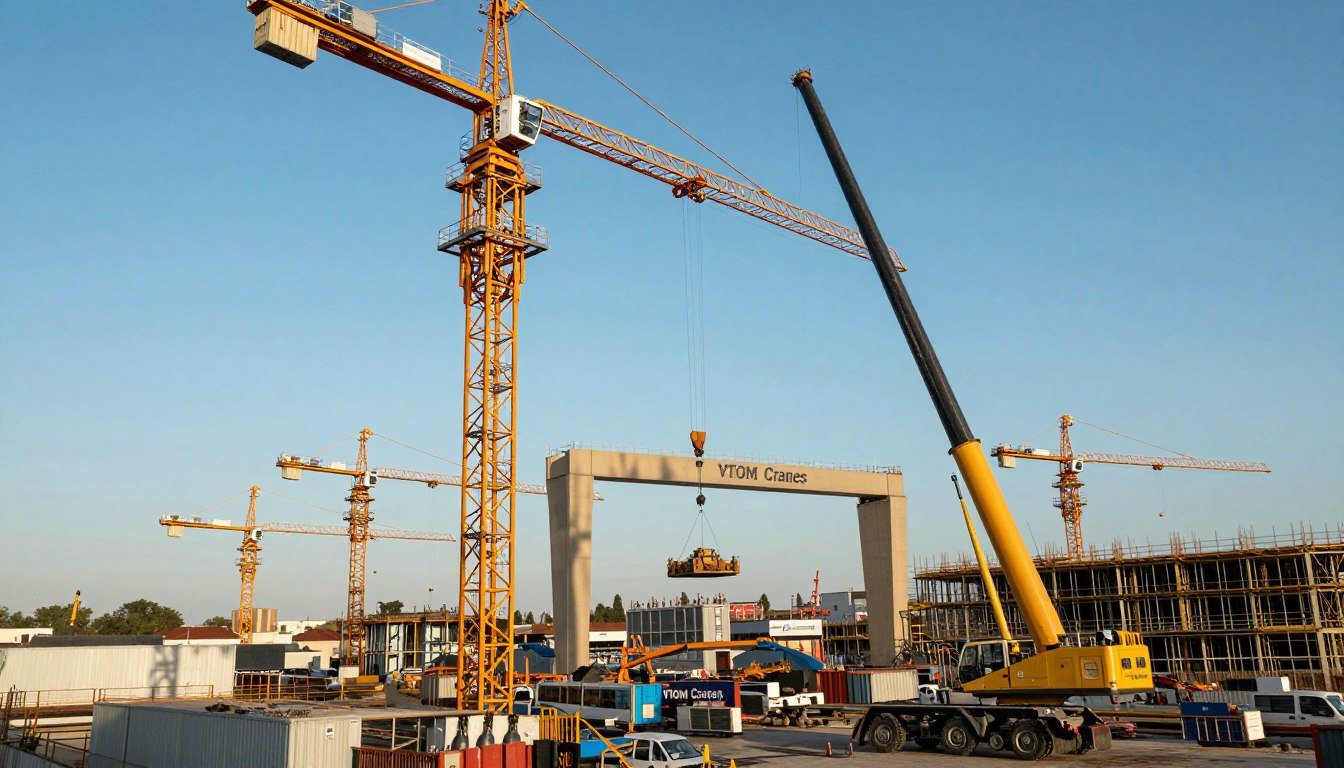
Welcome to the world of heavy machinery. If you’re new, learning how big loads move is crucial. In India, these machines are key for our growing industries.
Learning about the types of industrial cranes helps you see how places work better. These machines move materials from start to finish. They make sure every heavy lift is done safely and precisely.
Knowing your gear is important, whether you’re at a port or a factory. This guide will show you the options today. Let’s see how these tools make work smoother across the country.
Key Takeaways
- Heavy lifting equipment is essential for India’s infrastructure growth.
- Proper machinery selection directly impacts workplace safety standards.
- Cranes bridge the gap between raw material handling and final production.
- Understanding equipment mechanics improves overall operational efficiency.
- Beginners should focus on matching the machine to the specific job site needs.
Understanding the Role of Industrial Lifting Equipment
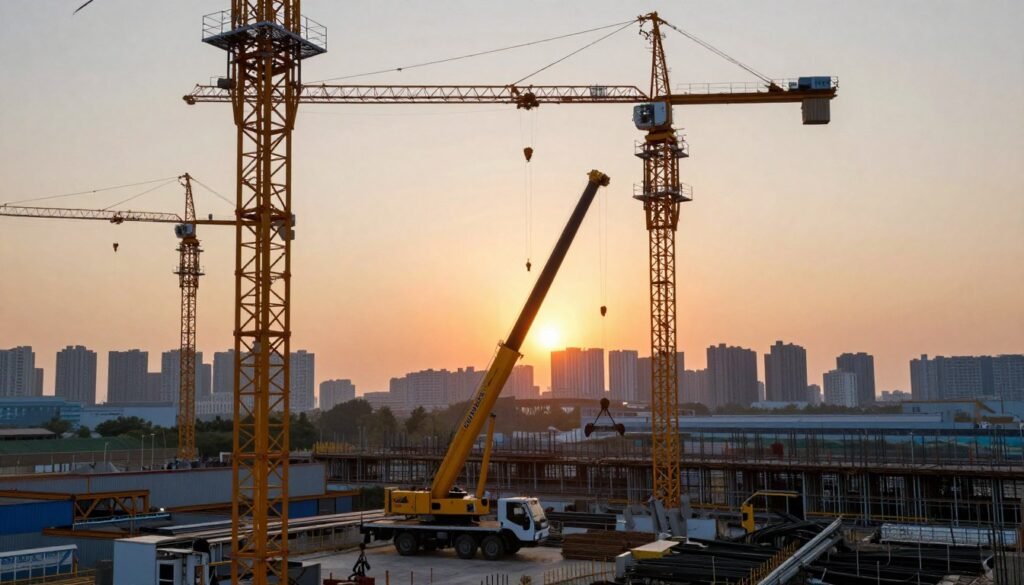
Every productive warehouse has a system of industrial lifting equipment at its core. These machines are key for moving heavy loads that are too big for people to handle. They use levers and pulleys to make it easy and precise to move big parts.
These tools are crucial for safety and better work output. When companies get the right types of lifting equipment, they lessen the physical burden on workers. This helps avoid accidents and injuries, which is very important in today’s industrial settings in India.
Managers need to pick the right machinery for their needs. Choosing the right industrial crane types makes sure tasks are done well. The right choice is key for operational sustainability and success.
These systems also help with precise tasks in manufacturing. Having different lifting equipment makes work flow better. Knowing about different crane types helps managers create a safer and more productive place for everyone.
Essential Types of Industrial Cranes for Modern Facilities
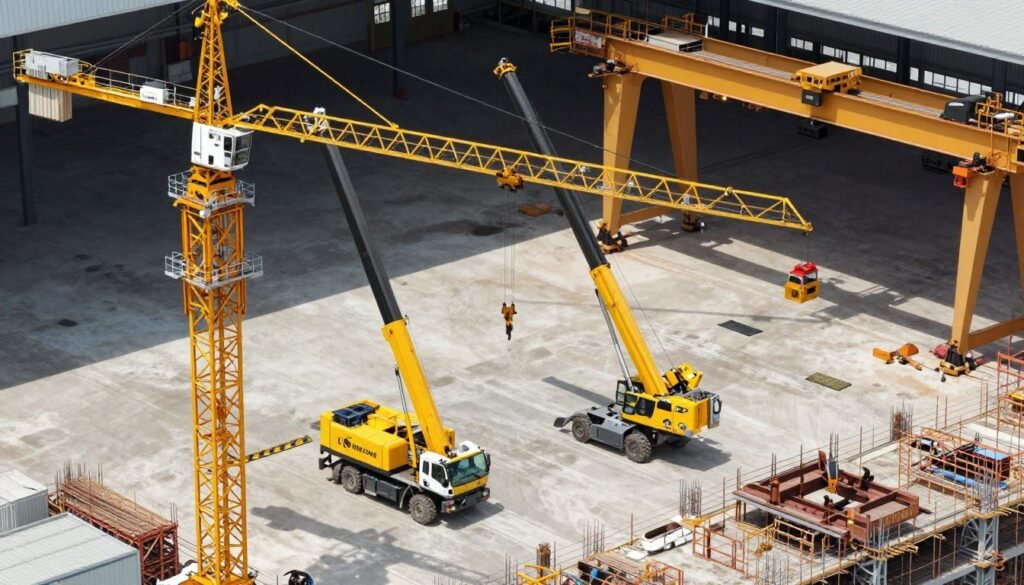
Industrial cranes come in many types, each with its own design and use. Knowing the differences is key to staying ahead. Choosing the right crane is crucial for less downtime and keeping your work safe and efficient.
Crane types fall into two main groups: static and mobile. Static cranes stay in one place, like on a wall or ceiling. They’re great for tasks you do over and over. On the other hand, mobile cranes move around, perfect for places where things change a lot.
When picking a crane, think about what you need to lift, your space, and how often you’ll use it. Making a smart choice means getting the most from your investment.
The table below shows the main differences between static and mobile cranes. It can help you plan better:
| Feature | Static Cranes | Mobile Cranes |
|---|---|---|
| Mobility | Fixed position | High site mobility |
| Primary Use | Repetitive production | Versatile, varied tasks |
| Installation | Permanent structure | Rapid deployment |
| Best For | Indoor assembly lines | Outdoor construction |
By understanding these crane types, you can pick the best for your facility. The right equipment boosts safety and improves productivity in your work.
Overhead Cranes for Indoor Manufacturing
Modern Indian manufacturing plants focus on saving floor space and ensuring safe lifting. They often use overhead cranes for this purpose. These cranes are key to efficient indoor material handling.
These systems have parallel runways along a building’s length. A bridge moves across these runways, allowing for precise movement of heavy items. Efficiency and safety are the main benefits of using these lifting solutions.
Single Girder Overhead Cranes
Single girder overhead cranes are popular for lighter loads. They have a single beam supported by two end trucks.
They are lightweight, which means less stress on the building. This makes them a cost-effective choice for smaller units in India.
Double Girder Overhead Cranes
Double girder overhead cranes are for heavy-duty lifting. They have two beams to support the trolley and hoist.
They have greater hook height and are best for heavy loads. These systems are durable, even in tough industrial cycles.
Underhung Crane Systems
Underhung overhead cranes hang from the ceiling. They’re great for places where floor space is very limited.
They use the roof structure for maximum floor coverage. These cranes are perfect for assembly lines needing flexible movement without blocking the floor.
| Crane Type | Best Use Case | Load Capacity |
|---|---|---|
| Single Girder | Light to Medium | Low to Moderate |
| Double Girder | Heavy Duty | High |
| Underhung | Space Saving | Low to Moderate |
Gantry Cranes for Versatile Outdoor Operations
Industrial operations often need to lift heavy things in places where overhead runways can’t go. In these areas, gantry cranes are the main solution. They help move big loads in shipyards, ports, and big manufacturing yards.
These systems have legs that move on wheels or tracks. This lets them work well without needing a building’s support.
Full Gantry Crane Configurations
A full gantry system has two legs that move on ground-level rails. This setup is highly stable and great for heavy-duty tasks. It’s perfect when the crane needs to cover a wide area.
Since they’re supported by their own legs, these gantry cranes can lift huge weights. They’re the top pick for big logistics and outdoor construction sites.
Semi-Gantry Crane Systems
Semi-gantry systems are a special mix for places with little space. One side of the crane moves on a runway attached to the building wall. The other side is supported by a leg on the ground.
This setup saves space by using what’s already there. It’s a cost-effective way to add lifting power to a production line without needing a full runway system.
Portable Gantry Cranes for Workshops
For smaller tasks or maintenance, portable gantry cranes are super flexible. They’re mounted on heavy-duty casters, so you can move them to different spots as needed.
They’re ideal for workshops where lifting needs change often. Their compact design means they don’t get in the way when not in use.
| Crane Type | Primary Support | Best Use Case |
|---|---|---|
| Full Gantry | Two ground rails | Heavy outdoor logistics |
| Semi-Gantry | One wall rail, one ground rail | Space-constrained facilities |
| Portable Gantry | Casters or wheels | Workshop maintenance |
Jib Cranes for Precision and Small-Scale Tasks
If your facility needs exact lifting, jib cranes are the answer. They have a horizontal arm with a hoist, attached to a mast or wall. They’re exceptionally efficient for moving materials along assembly lines or in specific workstations.
Wall-Mounted Jib Cranes
Wall-mounted units are great for places where space is limited. They attach to a building column or wall, saving floor space. This setup keeps the area below the boom clear and free.
These systems are favored for light tasks needing a small range of motion. They offer smooth rotation and quick access to materials. This boosts productivity in tight spaces.
Floor-Mounted Pillar Jib Cranes
Floor-mounted pillar designs offer more stability and a wider range of motion. These jib cranes are anchored to the concrete floor, supporting heavier loads. They rotate fully, covering all areas around the pillar.
These systems are highly versatile, ideal for loading and unloading machines or moving parts between stations. They stand alone, not needing the building walls for support. Investing in these jib cranes ensures reliability for your toughest small-scale lifting needs.
Mobile Cranes for Flexibility and Site Mobility
For contractors who need to move fast, mobile cranes are key. They sit on special vehicles or tracks, making it easy to move between sites. This makes them perfect for short-term projects where things change often.
Crawler Cranes for Rough Terrain
Crawler cranes have heavy-duty tracks for unmatched stability on tough ground. They spread their weight, making them great for muddy or sandy areas. This makes them the top choice for heavy lifting in tough spots.
Truck-Mounted Cranes for Rapid Deployment
For quick work, truck-mounted mobile cranes are the best. They’re built on truck frames, so they can drive fast to different sites. This means they can start lifting right away when they get there.
| Feature | Crawler Crane | Truck-Mounted Crane |
|---|---|---|
| Primary Mobility | Tracks | Wheels |
| Terrain Suitability | Soft/Uneven | Paved/Hard |
| Deployment Speed | Moderate | High |
| Best Use Case | Heavy Construction | Rapid mobile cranes tasks |
Tower Cranes for Large-Scale Construction Projects
When you look at a modern city’s skyline, you see the work of tower cranes. These machines are key for building high-rise structures. They have the height and strength needed for complex projects. Because they are anchored firmly to the ground, they are stable at high elevations.
Choosing the right crane depends on the site’s needs. Engineers must think about the building’s size and the area around it. This ensures both efficiency and safety.
Hammerhead Tower Cranes
The hammerhead crane is well-known on construction sites. It has a fixed horizontal jib that moves loads back and forth. This design works well for open areas where there’s room to move.
These tower cranes are simple and can handle heavy loads. They offer a steady reach, making them reliable for projects without space issues.
Luffing Jib Tower Cranes
In crowded cities, luffing jib cranes are the best choice. Their jib can be raised or lowered, allowing them to work in tight spaces. This is called luffing.
By changing the jib’s angle, operators can move around obstacles easily. These tower cranes are flexible for complex, dense construction sites.
| Feature | Hammerhead | Luffing Jib |
|---|---|---|
| Jib Movement | Fixed Horizontal | Vertical Luffing |
| Best Use | Open Sites | Tight Urban Spaces |
| Primary Benefit | High Efficiency | Spatial Flexibility |
| Tower Cranes Type | Standard | Specialized |
Conclusion
Choosing the right machinery changes how your facility handles heavy loads. It gives you an edge by matching tasks with the right equipment. This approach cuts down on downtime and keeps your team safe.
Buying top-notch gear from makers like Konecranes or Demag means reliability for years. These systems are key for modern production and construction in India. Keeping them in good shape helps you stay on schedule and save money.
Look at your current work flow to find where you can improve. Using advanced lifting equipment lets your team work with complex materials better. Talk to local engineering experts to see how custom cranes can help your growth.
Your focus on safety and doing things right starts with smart equipment choices. Share your crane experiences in industry forums. This helps everyone make the work place safer and more efficient.
About Us
OM Cranes is a trusted industrial crane manufacturer and service provider offering advanced lifting solutions for industries across Pune, Pimpri Chinchwad, and Chikhali. The company specializes in different types of industrial cranes including EOT cranes, gantry cranes, jib cranes, overhead cranes, and customized material handling systems for factories, warehouses, and manufacturing units.
With a focus on safety, performance, and durability, OM Cranes provides crane design, manufacturing, installation, maintenance, and repair services tailored to industrial requirements. Their solutions help businesses improve material handling efficiency, reduce downtime, and ensure smooth industrial operations across multiple sectors.
FAQs
1. What are the different types of industrial cranes?
Industrial cranes include EOT cranes, gantry cranes, jib cranes, overhead cranes, workstation cranes, and chain hoist cranes used for lifting and moving heavy materials in industries and warehouses.
2. Which industrial crane is best for factories in Pune?
EOT cranes and overhead cranes are widely used in Pune factories because they provide efficient material handling, high lifting capacity, and smooth workflow for manufacturing operations.
3. Does OM Cranes provide crane installation services in Pimpri Chinchwad?
Yes, OM Cranes provides industrial crane installation, maintenance, and repair services in Pimpri Chinchwad for warehouses, factories, and industrial facilities.
4. What is the use of gantry cranes in Chikhali industries?
Gantry cranes are commonly used in Chikhali industries for heavy-duty outdoor lifting applications, material loading, fabrication work, and handling large industrial components.
5. Why choose OM Cranes for industrial crane solutions in Pune?
OM Cranes offers reliable industrial crane solutions with customized designs, quality manufacturing, professional installation, and efficient after-sales support for businesses in Pune and nearby industrial areas.
 Previous Post
 Next Post